
When Iron Rusts - Part 1
Cathedral of the Crows Bonus Content

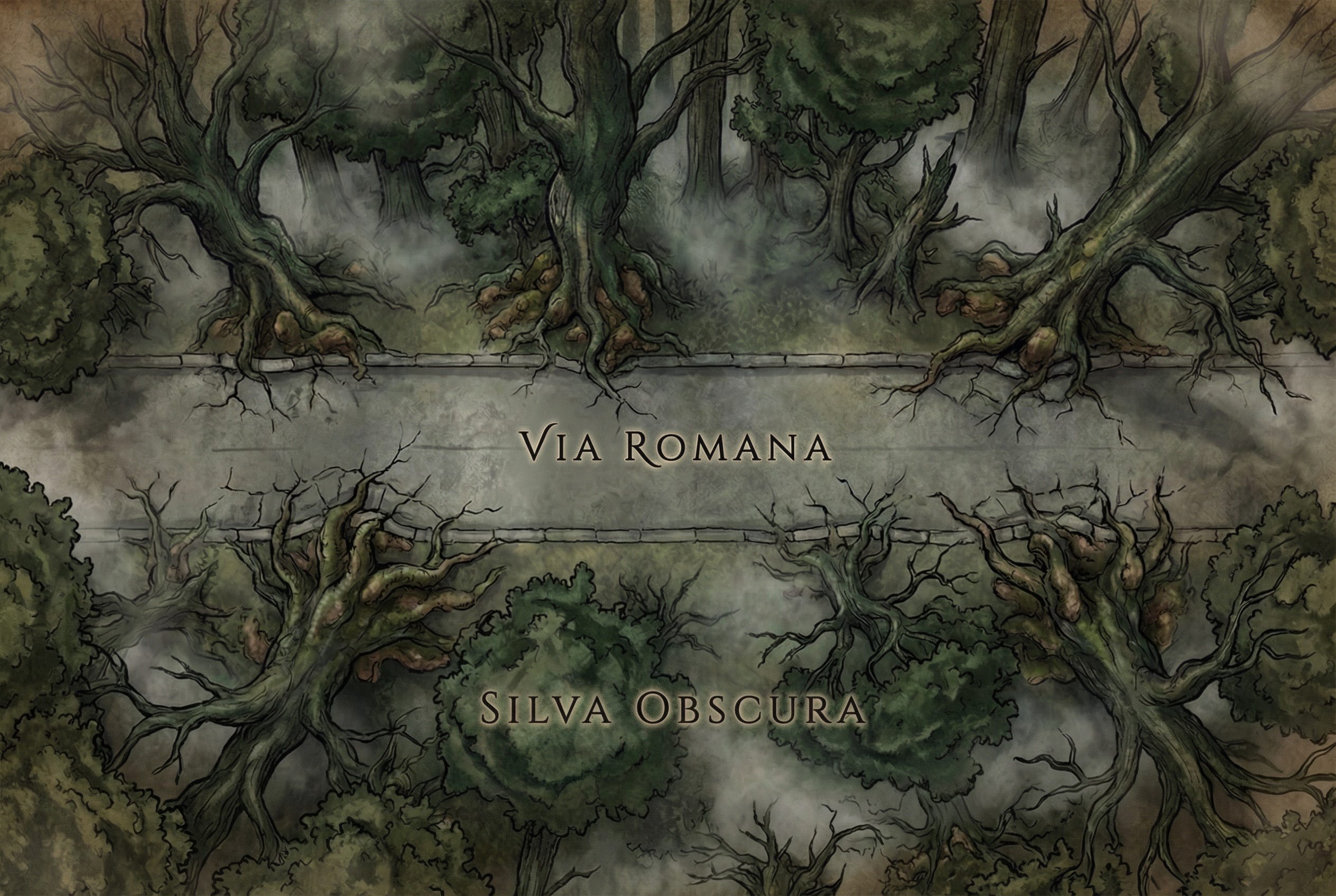
Before the cathedral. Before the priest and the laundress. Before the nun and the knight. Before the moss learned to wait… there was a road, and a woman who refused to move.
Prologue: The Seed and the Stone
Before the roads, the land breathed.
A pulse that began in the bedrock and traveled upward through limestone and clay and the tangled root systems of oaks that had been old when the glaciers retreated. It moved through the soil the way blood moves through a body, carrying everything that mattered to places that would die without it.
The Spring was the heart.
It sat in a hollow at the center of the grove, a pool of water so clear that the stones at the bottom seemed to float in air. The water was cold in summer and warm in winter. It rose from a crack in the limestone that went down farther than anyone had ever measured. The druids said it went to the center of the earth. The farmers said it went to the place where the dead waited. The children said it went to the place where the trees dreamed. Nobody argued about who was right.
The grove grew around the Spring the way a body grows around a heart. The oaks were massive, their trunks wider than a man could embrace, their roots woven through the bedrock like fingers laced in prayer. They were not separate trees. They were one organism, connected beneath the soil by a network of roots and fungal threads that shared water and nutrients and memory.
The people who tended the grove understood this. They had understood it for longer than they had possessed words to describe it. They called the network the Root. They called themselves its keepers. They knelt at the Spring and listened to the pulse and translated its rhythms into songs that kept the memory alive when the world above forgot.
The world above was always forgetting. Empires rose and named the dirt. Languages calcified into law. Men built walls and called them civilization and convinced themselves the walls had been there all along.
The Root did not argue with walls. It grew beneath them, patient as geology, and waited for the stone to crack.
And now, from the south, a new sound. Iron on stone. Stone on earth. The plans of men who believed the shortest distance between two points was the only distance that mattered.
The road was coming.
The Root felt the vibration of the first stake driven into the peat, miles away.
It breathed.
And it waited.
Chapter One: The Keeper’s Morning
The child’s breathing woke her.
Not Mared’s breathing—the absence of it. The pause between inhale and exhale that stretched a half-second too long, the hitch in the rhythm that pulled Elowen out of sleep the way a hand pulls a woman from water.
She was on her feet before her eyes were open.
The hut was dark, the fire banked to coals, the air thick with the smell of willow bark and sour fever sweat. Mared lay on the low pallet by the wall, small and burning, her shift damp and twisted around her thin body. Five years old. Three days sick. A cough that had started in the chest and climbed into the throat and turned breathing into a struggle.
Elowen knelt. She placed her hands over the girl’s ribs, an inch above the skin, and felt for the heat. It was there. Stubborn, concentrated, the body at war with something it couldn’t name.
She pressed down. She felt the lungs working beneath the bone. The wet rattle. The labored, lurching rhythm.
She hummed. Low, steady, matching the child’s breathing. The melody was older than the words the druids set to it. A tune the body recognized the way it recognized warmth or the voice of its mother. She had learned it from Brennus, who had learned it from his grandmother, who had learned it from the oak.
Under her palms, the heat began to shift. Moving downward, drawn through the child’s body toward the earth beneath the packed-dirt floor, the way water is drawn through roots.
Mared’s breathing steadied. The hitch eased. The rattle thinned.
Elowen held her hands where they were and kept humming until the coals dimmed and the first gray light crept through the gaps in the thatch. Her knees ached. Her eyes burned. But she did not move.
At dawn, the fever broke.
Mared opened her eyes. They were glassy, confused, but alert. She looked up at Elowen with the unguarded gaze of a child surfacing from deep water.
“There you are,” Elowen said.
Mared’s mother let out a sound—half sob, half prayer—and crossed the hut in two steps, gathering the child against her chest.
Elowen stood. She gathered her herbs: the unused poultice, the jar of meadowsweet salve, the strips of linen she’d brought in case the fever turned violent. Her hands were steady. They were always steady during the work. It was after that the shaking came.
She let herself out of the hut.
The air hit her like cold water. Sharp, clean, smelling of wet earth and pine resin and the faint green sweetness of moss. The camp was waking. Smoke rising from cook fires. Children splashing through puddles left by last night’s rain. A dog barking at something in the trees.
She walked toward the river.
The path took her along the ridge where the soil was driest, past the huts and the drying racks and the stone mortar where she ground her herbs. She walked without hurrying. There was nowhere to hurry to. The rhythm of the camp was the rhythm of the day—meals to cook, animals to tend, children to watch, the sick to visit, the pregnant to reassure.
This was the work. Not the singing or the ceremonies or the trances at the Spring. This. The daily tending.
At the river, she found Rhiannon sitting on the flat stone by the ford, her feet in the shallows, her belly enormous beneath her loosened tunic.
“She kicked me in the bladder at moonrise and I have not forgiven her,” Rhiannon said.
Elowen knelt beside her. She placed her hands on Rhiannon’s belly. Head down. Good position. The baby shifted under her palms, a slow, rolling movement, a body turning in its own dark water.
“Two weeks,” Elowen said. “Perhaps less.”
“Promise you will be there.”
“I promise.”
She mixed a tea from dried yarrow and chamomile. She sat with Rhiannon while she drank it. She held her hand.
Then she stood. She had three more visits to make before midday. The bone-setter’s wife. Old Nerys. The boy at the edge of camp with a cut foot going to rot.
At the central clearing, she paused.
Brennus was sitting by the communal fire, mending a fishing net. His fingers worked the knots with the patience of a man who had been doing this particular task for longer than most people had been alive. He was old—the villagers said impossibly old, though Elowen suspected he was seventy and had earned his mythology by outliving everyone who could contradict him. Deep lines in a face that had forgotten how to be soft. A nose broken twice and set once. Eyes the color of peat water, catching light only at the edges.
He did not look up as she passed. But he spoke.
“The ground was restless last night.”
Elowen stopped.
“I felt it too,” she said. “In the hut. During Mared’s fever.”
“Not the fever. Something else.” His fingers stilled on the net. “A vibration. Rhythmic. Coming from the south.”
She waited.
“Iron on stone,” Brennus said. “Stone on earth. They are driving stakes. Survey markers, if I had to guess. The pattern is too regular for construction.” He resumed his work. “They are measuring.”
“How far?”
“Three miles. Perhaps less. The Root carries sound differently through wet ground.”
Three miles. The grove extended a mile in every direction from the Spring. The cleared fields beyond that—the land the families farmed, the pastures where the goats grazed—ran another mile before the scrubland began.
Three miles meant the edge of the scrubland.
“They will reach the fields by midsummer,” Elowen said.
“Sooner, if they are legionaries. Romans do not stop for weather.”
“What do we do?”
Brennus tied a knot. He held the net up to the light, inspecting it.
“We tend the grove,” he said. “We mind the Spring. We do what keepers do.”
“And when they arrive?”
He looked at her then. His peat-water eyes were steady.
“Then we will see what the earth asks.”
He went back to his net.
Elowen stood in the clearing for a moment longer. The cook fires smoked. The children played. The sounds of the camp were the sounds of ordinary life—voices and footsteps and the clatter of wooden bowls.
Beneath it, if she listened, the vibration. Faint. Rhythmic. Getting closer.
She walked to the Spring.
The twelve oaks stood in their rough circle, branches woven into a living vault overhead. The water was still today, a mirror reflecting the canopy. She knelt at the edge and placed her hands flat on the surface.
Beneath her palms, the Root’s pulse. Steady. Patient. Unchanged.
But today she felt something else. A tremor in the deeper layers, like a string tuned too tight.
Elowen closed her eyes.
The tug came immediately. South and east, toward the sound of iron on stone. Not a voice. Not a command. Just a pull, the way a current pulls—patient, constant, indifferent to whether she followed.
She opened her eyes.
She dried her hands on her tunic. She stood.
She did not follow the pull. Not today. Today there was a bone-setter’s wife to see, and old Nerys with her tremors, and a boy with a cut foot, and a pregnant woman who needed to know she would not be alone.
But all day, as she ground herbs and mixed poultices and held hands and checked wounds, she felt it. The pull. South and east, every time she reached a fork in the path.
Getting closer.
Chapter Two
The Scar in the Earth
She went on a morning when the mist was low.
She told herself it was reconnaissance. The camp needed to know what was coming—how many soldiers, how fast the construction moved, how close the road had gotten since Brennus first felt the vibrations three weeks ago. Someone had to go. She was the keeper. It was her responsibility.
She did not tell Brennus she was going.
She walked south through the grove, past the outer ring of oaks, past the cleared fields where the barley was beginning to head, past the stream at the ford where the water ran shallow over white stones. The mist thinned as the ground rose. The trees gave way to scrubland—gorse and heather and the low, wind-bent hawthorns that grew where nothing else could.
And then the scrubland ended, and the road began.
She saw it before she heard it. A line of gray cutting through the green, straight as a blade, running east to west without curve or deviation. The gravel was pale, freshly laid, still sharp-edged. On either side, the earth had been stripped—topsoil removed, roots torn out, the ground leveled and tamped flat. The scar extended behind and before her as far as she could see.
It was the most violent thing she had ever seen done to the land.
Not the burning of the northern grove—that had been fire, chaotic and brief. This was different. This was methodical. This was a wound inflicted with precision and maintained by design. The road did not ask the land’s permission. It did not follow the contour of the hill or the bend of the river. It went straight, and where the land disagreed, the land was removed.
She crouched in the heather at the edge of the cleared zone and watched.
The construction site sprawled below her. Four hundred men, maybe more, moving in organized lines, carrying stone and gravel in wicker baskets, hammering iron stakes into the peat at regular intervals. The sound was constant—the ring of hammers, the scrape of shovels, the bark of orders in a language she did not speak.
She could feel the stakes. Each one was a bright point of pain in the network beneath the soil, like needles driven into a nerve. The Root flinched around them, contracting, pulling away from the iron the way flesh pulls away from a burn. She counted twelve stakes in the nearest section. Twelve small wounds in a system that stretched for miles.
She pressed her palm flat against the ground.
Her teeth ached. A low, persistent throb, as though the stakes were being hammered into her jaw. She closed her eyes and the construction opened up beneath her—the weight of four hundred men, the vibration of their hammers, the particular heaviness of their iron. And among them, moving along the road’s edge, a single figure whose weight pressed differently into the ground. Heavier than the others. Not larger—more concentrated.
She opened her eyes.
He was walking the line alone. The others worked in groups, in shifts, moving with the coordinated rhythm of men following orders. This one walked alone, ahead of them, checking each stake, crouching to scrape the surface of the iron, then moving to the next. His armor was different from the workers’—heavier, with a red crest on the helmet and brass fittings that caught the gray light.
He stopped.
He was looking at the treeline. Looking at the place where the scrubland met the heather. Looking, she realized, at the exact spot where she was crouching.
She did not know if he could see her. The mist was thin but present, and the heather was high enough to screen her if she stayed low. She could wait for him to turn away. She could crawl back through the gorse and return to the grove and report what she’d seen.
The pull in her chest said otherwise.
The earth wanted her to stand.
She stood.
The distance between them was two hundred paces. She could see his face—hard, angular, carved by discipline and weather. Gray eyes, the color scrubbed out of them by too much sky and stone.
He saw her.
She felt the moment of his seeing like a change in air pressure.
He began walking toward her.
She did not run. She should have. But beneath the pull was a certainty she did not understand and could not argue with.
She knew this man. Not from memory. From somewhere older than memory.
He stopped ten paces from her. Close enough to speak. His hand rested on the sword at his hip—not threatening, habitual.
“You are standing on the Emperor’s road,” he said.
His accent was strange—the local dialect flattened and roughened, learned from necessity rather than love.
“I am standing on the root,” she said.
He frowned. The expression deepened the lines around his eyes and mouth and made him look older than she suspected he was. Beneath the armor, beneath the discipline, she could see the architecture of a body that had been young once and had been used hard since.
“You are driving iron into a vein,” she continued. She pointed with her chin toward the nearest survey stake, an iron post hammered into the black peat, already filmed with orange at the surface. “This is not wise.”
“We are building a road,” he said. “It brings order. Civility. Trade.”
“It brings a scar. And scars do not trade.”
She should not have stepped closer. Every instinct Brennus had taught her—every lesson about the Romans, their speed, their violence, the way they converted curiosity into conquest—said to keep her distance. To deliver the warning and disappear.
She stepped closer. She was inside the reach of his sword now. Close enough to see the grain of the brass on his breastplate, the eagle embossed in the metal, the small dents and scratches where the armor had done its work.
Close enough to feel his heat.
The iron should have been cold. But she felt warmth coming off him—not the heat of exertion but something deeper, something that lived in the brass the way sap lived in heartwood. His body had soaked into the metal until the armor was not a shell but a skin.
Her hand moved.
Her fingers crossed the distance between them and pressed flat against his breastplate, over the brass eagle, and the heat that met her palm was so fierce that she nearly pulled away.
His heartbeat. Through the brass. Hammering.
She felt the shape of him through the metal the way she felt the shape of sickness through skin. He was wounded. Not in the flesh. Somewhere older than flesh.
Grief. So old he’d mistaken it for his soul.
He caught her wrist.
His grip was fast and hard. His fingers closed around the bones with a pressure that said he could break them. His eyes said he would not.
“Go back to your woods, Priestess,” he said. His voice had changed. “The road is coming. And the road does not stop.”
She looked at his hand on her wrist. She looked at his face. The gray eyes that were not, she realized, the color of stone. They were the color of ash. The color of something that had burned.
“I will see you again, Centurion,” she said. “When the iron rusts.”
He released her wrist.
She turned and walked toward the treeline. She did not look back.
She crossed the stream at the ford. The cold water bit her ankles. She paused in the current and pressed her palms together.
Her right hand was still warm. The one she had pressed against his armor.
She opened her hands. The right palm was flushed, the skin warm to the touch.
She stood in the cold stream and let the water run over her feet.
She climbed the bank and entered the forest. The canopy closed over her. The light shifted from flat gray to green-gold. The air thickened with loam and fern and the smell of wet bark.
She walked back to camp, because Rhiannon needed her tea and old Nerys needed her valerian and the boy’s cut foot needed checking and the world did not stop turning because a woman had touched a stranger’s armor and felt the earth move.
But all day, the warmth in her right hand did not fade.
And all night, lying on her pallet in the dark, she pressed that warm palm against the cool oak of the wall beside her bed and felt the wood’s grain under her skin. The tree’s old pulse.
And beneath it, faint, the newer vibration. Iron on stone. Stone on earth.
Closer now.
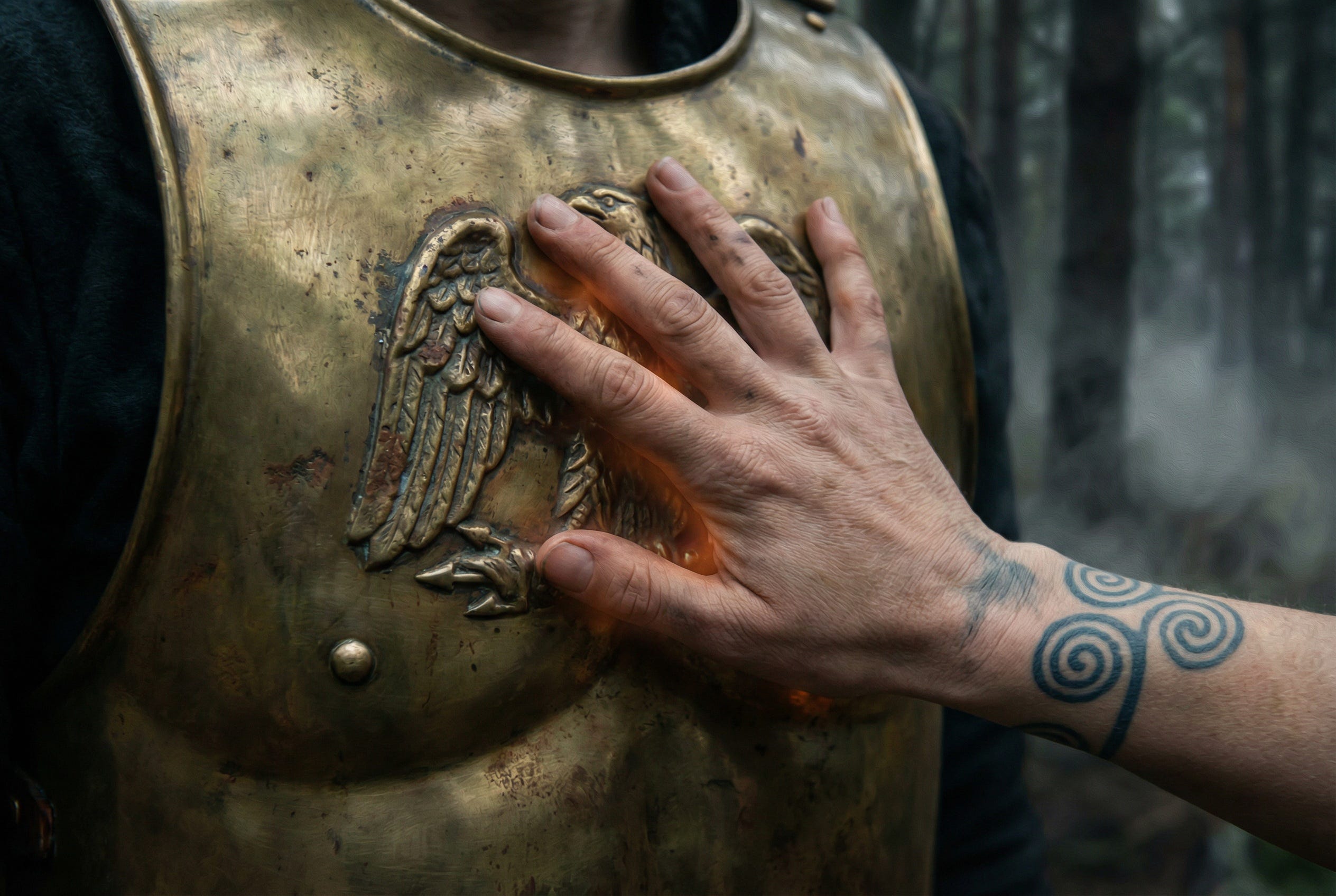
A centurion who built walls. A priestess who grew through them. A thousand years later, a priest and a laundress would inherit the debt they set.
The story of how that debt was made—and why the moss still remembers—continues next week.
If you’ve already read Mirror Heart and Gilded Blood, you know how this ends. You know the coin. You know the brand. You know the seed that cracks open in the dark.
If you haven’t—this is where it all begins.
